Claude’s AI Content Marking: What It Means for Transparency and Trust


Have you ever wondered whether the blog post, email, or image you’re reading was written by a person or generated by AI?
As AI tools like Claude become part of everyday content creation, that question is getting harder to answer just by looking. Text reads naturally, images look polished, and nothing on the page tells you where it came from.
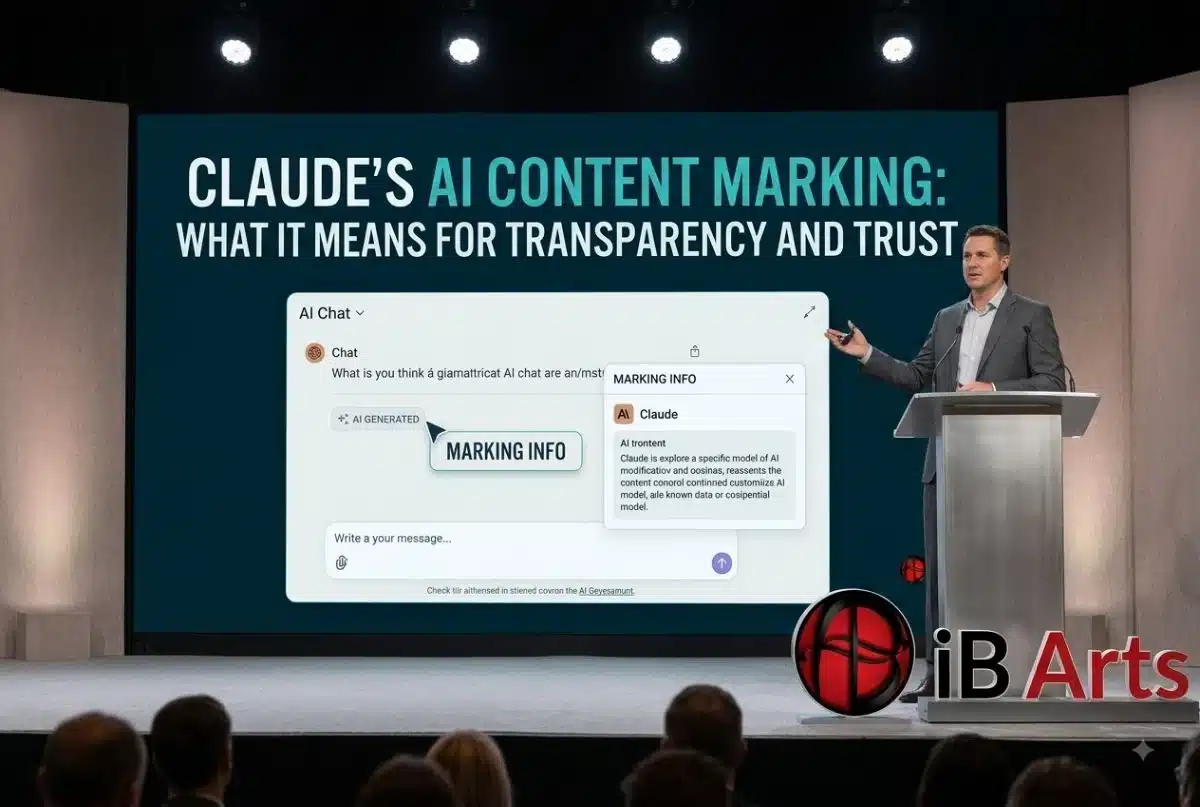
This is exactly the gap Anthropic is addressing with Claude’s new content marking system. It is not a visible label or a stamp on your content, it is an invisible signal built into the content itself.
What do you need to know about it?
In this article, I am going to walk you through what AI content marking is, why Claude introduced it, how it actually works, and what it means for anyone publishing AI-assisted content.
Table Of Contents
| 1. | Introduction |
| 2. | Why AI Content Transparency Needs a New Approach |
| 3. | What Is AI Content Marking? |
| 4. | Key Characteristics of Claude’s Content Marking |
| 5. | Why It Matters: AI Content Marking vs. Plagiarism Detection |
| 6. | How Claude’s Content Marking Actually Works |
| 7. | What Does AI Content Marking Mean for Businesses? |
| 8. | Conclusion |
| 9. | FAQs |
| 10. | Ready to Understand AI Content Provenance? |
Why AI Content Transparency Needs a New Approach
Generative AI is trained to produce fluent, natural-sounding output. That fluency is exactly what makes AI-generated content difficult to distinguish from human writing at a glance. Regulators, publishers, and readers increasingly want a way to know:
- Whether a piece of content was generated by an AI model
- Whether an image or file was AI-processed
- Whether that signal survives copying, editing, or reformatting
This is different from traditional content moderation, because the goal is not to block or flag AI content, it is to make its origin traceable, without changing how the content reads or looks.
Anthropic’s approach responds directly to this need, driven in large part by new regulatory requirements in the European Union.
What Is AI Content Marking?
AI content marking is a machine-readable signal embedded into content generated by an AI model, allowing that content to be identified as AI-generated using a detection tool, without changing how it appears to a normal reader.
For example, if Claude writes a paragraph for your blog post:
You see:
“Machine-readable content helps AI systems understand your website more accurately, increasing the chances your content gets cited in AI-generated answers.”
What actually happened underneath:
- Claude wove an imperceptible statistical pattern into the specific word choices it made
- The pattern does not change meaning, tone, or readability
- The pattern can, in principle, be checked with a detection tool
Unlike a visible “Generated by AI” badge, this mark is invisible by design. It exists in the text itself, not as metadata bolted onto a file.
Key Characteristics of Claude’s Content Marking
Invisible by Design
The watermark does not change spelling, phrasing, tone, or formatting. A reader cannot tell whether content is marked just by reading it.
Travels With the Text
Because the mark lives in the actual word choices, it travels with the text when copied and pasted elsewhere, and it may survive light editing.
Weakens or Breaks With Heavy Editing
Heavy rewriting, paraphrasing, translation, or mixing AI text with human-written content can weaken the signal or make it undetectable, since the underlying word pattern no longer exists in the edited version.
Separate System for Files
For generated files such as .svg, .png, and .jpg, Claude uses a different method: signed provenance metadata following the C2PA industry standard, which signals the file was processed by Claude and can reveal if it has been tampered with.
Why It Matters: AI Content Marking vs. Plagiarism Detection
It is easy to confuse AI content marking with plagiarism detection, but they solve two different problems entirely.
| Plagiarism Detection | AI Content Marking |
|---|---|
| Compares text against existing published works | Detects a statistical pattern woven into generated text itself |
| Flags copied or unattributed content | Flags AI-origin content, even if fully original |
| Cares about authorship credit | Cares about AI vs. human origin |
| Requires a matching source to flag anything | Requires no external source – the mark lives in the text |
In short, plagiarism detection asks “did you copy someone else’s words?” while AI content marking asks “did a machine or a human write these words?” Content can be fully original and still carry an AI mark, and content can be AI-generated with no mark at all if it came from an unsupported model or was heavily edited.
How Claude’s Content Marking Actually Works
- Embedded text watermarks: An imperceptible pattern is woven into generated text at the model level, applying across Claude Platform, Claude.ai, Claude Code, Claude Cowork, and Claude Tag.
- Signed provenance metadata: Generated image files carry a C2PA-based digital signature confirming Claude processed the file.
- Model coverage: Marking applies to Claude models launched on or after August 2, 2026, with older models being retrofitted over time.
- Detection tooling: Anthropic has stated it is developing a detection tool and technical documentation so users and third parties can check content for Claude’s marks.
It is worth noting what this system does not do. A detected mark does not prove Claude originated every idea in a piece of content, since Claude is often used to proofread, translate, or lightly edit human-written work. Likewise, the absence of a mark does not prove content is human-written, since older models, heavy edits, or short excerpts can all leave no detectable trace.
What Does AI Content Marking Mean for Businesses?
For businesses, AI content marking is another reason to take a more structured approach to AI-assisted content. AI can support content creation, research, editing, and digital marketing, but businesses still need to ensure that the final content is useful, accurate, aligned with search intent, and consistent with their overall digital strategy.
This becomes particularly important when AI-assisted content is being published across a company’s website, blog, landing pages, and other digital channels. A strong SEO and digital marketing strategy can help businesses ensure that AI is being used to support their online presence rather than simply increasing the volume of content being published.
For businesses looking to strengthen their website, SEO, and broader online presence, working with an experienced digital marketing and web development team can help bring these different elements together.
Conclusion
As AI-generated content becomes a normal part of everyday publishing, invisible transparency signals like Claude’s content marking are becoming part of the infrastructure behind trustworthy AI use.
While this system will not catch every case, especially content that has been heavily rewritten, it represents a meaningful first step toward giving readers, platforms, and regulators a way to understand where content comes from.
Understanding how this marking works, and its real limitations, helps creators, businesses, and publishers use AI tools responsibly while staying transparent with their audiences.
FAQ:
AI content marking is an invisible, machine-readable signal embedded into AI-generated text or files, allowing the content’s AI origin to be identified using a detection tool.
No. The marking is invisible and does not add any badge, label, or visible symbol to the content. It does not change how the content reads or looks.
Yes. Heavy rewriting, paraphrasing, translation, or mixing AI text with human-written content can weaken or completely remove the detectable signal.
No. Plagiarism detection compares text against existing published sources to catch copying. AI content marking detects whether a model generated the text, regardless of whether the content is original.
Anthropic has stated it is developing a detection tool and technical documentation for this purpose, though a public detection tool has not been released yet.
Ready to Understand AI Content Provenance?
As AI-assisted content becomes standard practice, understanding how transparency systems like Claude’s content marking work helps you use AI tools responsibly, stay compliant with emerging regulations, and communicate clearly with your audience about how your content is created.