WordPress vs. Custom Website Development: Which Is Right For Your Business?


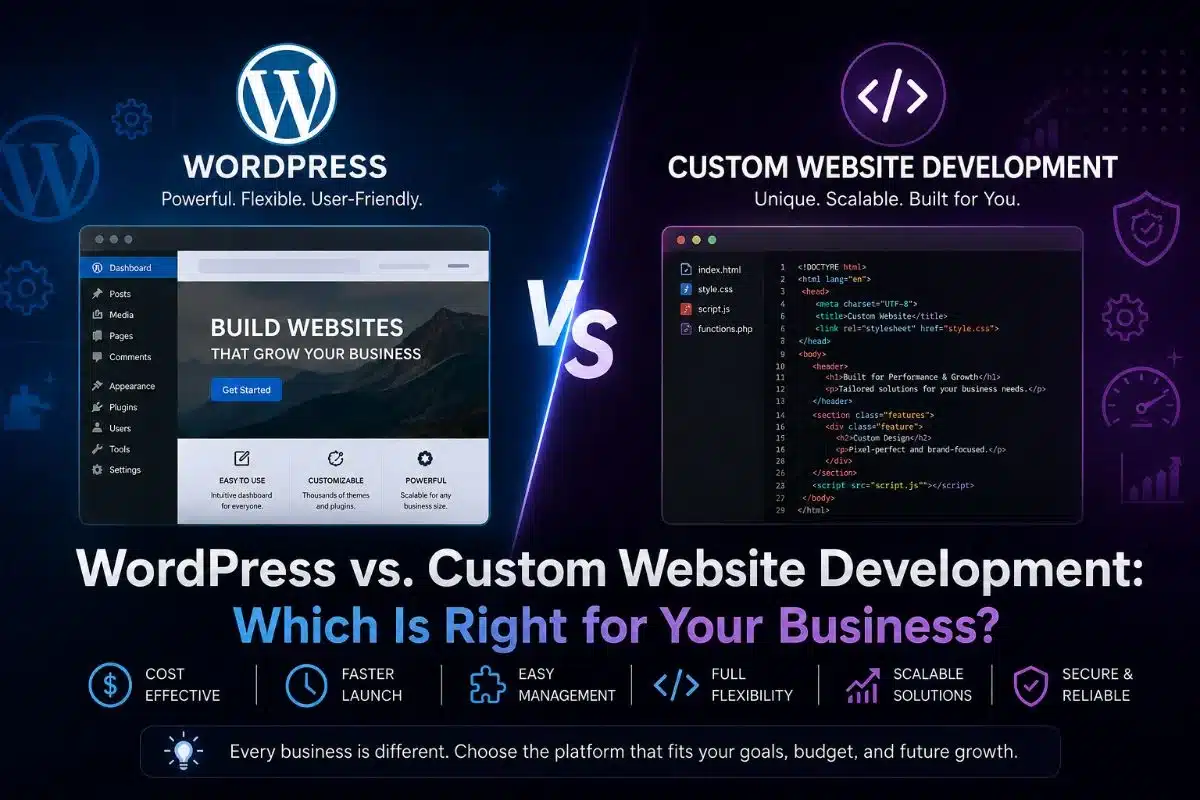
When it comes to discovering your business in front of the eyes of the global audience, the first thing that comes to our minds is having our own business website, right?
But then, just as you plan on building one, you get stuck in the development process. WordPress vs. Custom Website Development: Which One Should You Choose?
Almost everyone has been through this situation at least once before building a website. Me too. But I wish what I knew earlier was a clear difference in the pros and cons of both processes, which one fits my requirement better.
So, I am writing this article for you so you do not go through the same confusion. This article will walk you through the complete details of WordPress vs. custom website development and what is going to help you with your business needs.
Let’s have a small introduction before jumping into the comparison.
Table Of Contents
| 1. | Introduction |
| 2. | What Is WordPress Web Development? |
| 3. | What Is A Custom Website? |
| 4. | WordPress vs. Custom Website Development: What’s the difference? |
| 5. | Development Cost |
| 6. | Development Time |
| 7. | Design And Functionality |
| 8. | Scalability |
| 9. | SEO and Performance |
| 10. | Maintenance and Updates |
| 11. | Security |
| 12. | WordPress or Custom Website Development: Which One To Choose? |
| 13. | Conclusion |
| 14. | FAQ |
| 15. | Need Help Deciding? |
What Is WordPress Web Development?
WordPress is a content management system, or CMS, that uses pre-built themes and plugins to allow fast, cost-effective deployment.
What Is A Custom Website?
A custom website is coded from scratch using JavaScript, CSS, Laravel, etc., to deliver tailored functionality, elite performance, and total design.
WordPress vs. Custom Website Development: What’s the difference?
As this is clearly not a WordPress or custom website development tutorial, now I am going to give you an actual account of the difference between these two processes. Since this article is focused on your business need, let’s start with the most important factor: cost.
1. Development Cost
Investment in your website development is a huge decision than it seems. As you are just starting out, you may have a high or low budget. Whatever is your budget, that is not the main factor. What matters is investing in which type is going to give you advantage without compromising your launch.
WordPress generally has a lower starting cost because developers can use an existing CMS, themes, plugins, and established functionality.
On the other hand, custom website development usually costs more because functionality, architecture, interface, integrations, and backend systems may need to be developed
2. Development Time
Development time is usually faster for WordPress because this has existing components like themes, plugins, etc., which you can just select, and your site will be developed in some days.
On the other hand, for custom website development, it takes relatively longer than WordPress. Developers need to plan the architecture of each section separately and need to employ the functionality from scratch.
So, if you are a small business that needs a professional website quickly, you may benefit from WordPress, while your business developing a complex digital platform may justify the additional development time of a custom solution.
3. Design And Functionality
You can enable various customizations through WordPress’s customization options, as it provides a variety of designs and functionality.
However, for custom web development, it has greater control and development functionality. User experience, interfaces, workflows, business logic, integrations, backend functionality, and many more can be customized based on your preference.
A good WordPress website can be heavily customized. The difference is the level of control and how much functionality needs to be built from scratch.
4. Scalability
What happens when your business grows? Your website may need to handle more traffic, publish more content, support additional users, connect with new systems, or accommodate more complex business processes.
Both WordPress and custom websites can scale, but the right choice depends on how your website is built and what your business will require as it grows.
WordPress can support growing businesses with proper hosting, optimized code, database management, caching, and a carefully managed plugin ecosystem.
However, businesses with highly specialized workflows, complex integrations, or unique functionality may benefit from custom development. A custom solution can help the underlying architecture to be designed around specific scalability requirements from the beginning.
5. SEO and Performance
Both WordPress and custom websites can perform well in search. Neither platform is automatically better for SEO; results depend on how the website is developed, optimized, and maintained.
Factors such as page speed, mobile performance, Core Web Vitals, crawlability, technical SEO, structured data, and clean website architecture can affect search performance regardless of the development approach. WordPress also provides a convenient content management experience, while a custom website can give developers greater control over the underlying architecture and performance.
The better choice is therefore the one that allows your business to maintain a technically sound, fast, crawlable, and search-friendly website as it grows.
6. Maintenance and Updates
Neither WordPress nor custom development is maintenance-free. The difference is mainly in what needs to be maintained and who manages it.
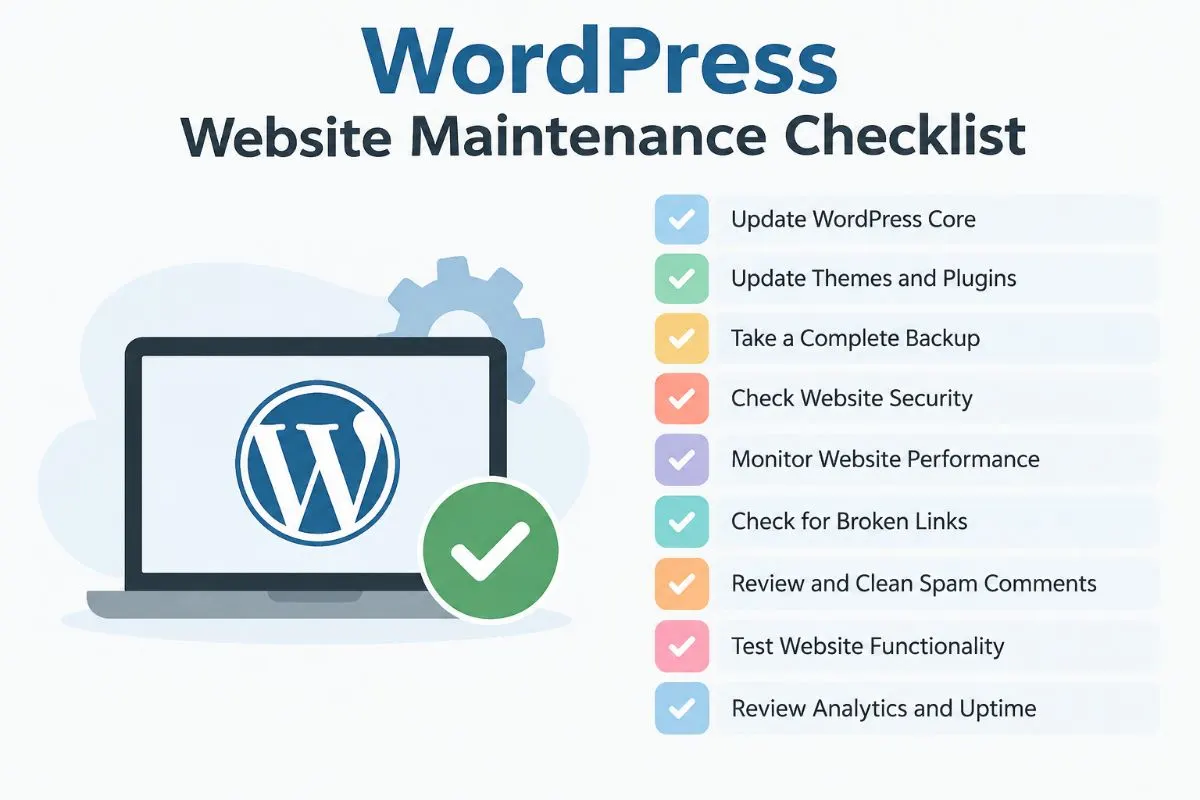
WordPress websites typically require regular core, plugin, and theme updates, along with compatibility checks, security monitoring, backups, and performance maintenance. Using poorly maintained plugins or making updates without proper testing can create additional issues.
Custom websites may require ongoing developer support, code maintenance, security updates, infrastructure management, and future feature development. Because the functionality is built specifically for the business, updates may require development work rather than simply installing an existing update.
The right choice should therefore account for your long-term maintenance resources and technical support requirements, not just the initial development cost.
7. Security
Website security depends more on implementation, configuration, and ongoing maintenance than on whether a website uses WordPress or custom development.
With WordPress, security involves choosing reliable themes and plugins, keeping the platform updated, using strong access controls, securing the hosting environment, and implementing appropriate security configurations. Unnecessary or poorly maintained third-party components can increase the attack surface.
Custom websites require attention to secure coding, authentication, access controls, dependency management, infrastructure security, and ongoing monitoring. While custom development provides greater control over the technology stack, that control also comes with the responsibility of maintaining the security of the code and infrastructure.
Ultimately, security should be treated as an ongoing development and maintenance responsibility, rather than assuming one approach is inherently more secure than the other.
TL;DR? Here is a comparison table to have a quick glance at both of their pros and cons.
| Factor | WordPress | Custom Development |
|---|---|---|
| Initial cost | Generally lower | Generally higher |
| Launch time | Faster | Usually longer |
| Design flexibility | High | Very high |
| Custom functionality | High with development | Very high |
| Content management | Excellent | Depends on implementation |
| Scalability | Good with proper architecture | Highly flexible |
| Maintenance | CMS/plugin maintenance | Developer maintenance |
| Integrations | Extensive ecosystem | Built to requirements |
| Best for | Most standard business websites | Complex or highly specialized requirements |
WordPress or Custom Website Development: Which One To Choose?
After reading the differences, the decision cannot be said, as ‘it depends’. It does, but not in a sense that you should leave as diplomatic.
Choose wordPress if, your priorities are speed, manageable cost, content management, and business functionality.
But your better option will be custom web development if you want unique functionality, maximum control of your website, and specialized scalability for your business.
But once again, the decision is yours as only you know what will work best for you.
Conclusion
Choosing between WordPress and custom website development is not about finding a universally better technology. It is about choosing the approach that fits your business goals, budget, functionality, growth plans, and ability to maintain the website over time.
WordPress can be a practical choice when you need a professional website quickly, want manageable development costs, and need an easy way to manage content. Custom development can make more sense when your business depends on unique functionality, complex workflows, specialized integrations, or greater control over the website architecture.
Before making the decision, look beyond the initial development cost. Consider what your website needs today, where your business is heading, and what you may need from the platform several years from now. The right development approach is the one that supports your business without creating unnecessary technical limitations.
FAQ:
Generally, WordPress has a lower initial development cost because it provides an existing CMS, themes, plugins, and other components. Custom development usually requires more development work, making the initial investment higher. However, the total cost should also consider maintenance, integrations, updates, and future development.
Not necessarily. A custom website provides greater control over functionality and architecture, but that does not make it automatically better. WordPress can be the better choice for businesses that need a flexible, manageable, and cost-effective website without highly specialized requirements.
Both can perform well in search. SEO depends more on factors such as website architecture, page speed, crawlability, mobile performance, structured data, Core Web Vitals, content, and ongoing technical optimization than on whether the website uses WordPress or custom development.
Yes. WordPress websites can be extensively customized through custom themes, plugins, code, integrations, and other development solutions. The important consideration is whether WordPress can efficiently accommodate the functionality and architecture your business requires.
Custom development may be appropriate when a business requires unique functionality, complex workflows, specialized integrations, highly specific user experiences, or an architecture that standard CMS solutions cannot efficiently provide. It can also be considered when long-term technical flexibility is a major business requirement.
Need Help Deciding?
Choosing between WordPress and custom development can be difficult when both options seem capable of meeting your requirements. Start by looking at your current website needs, expected growth, required functionality, budget, and long-term maintenance requirements.
If you’re still unsure which approach makes sense, talk to our web development expert about your requirements and get an objective recommendation before you commit to a development path.