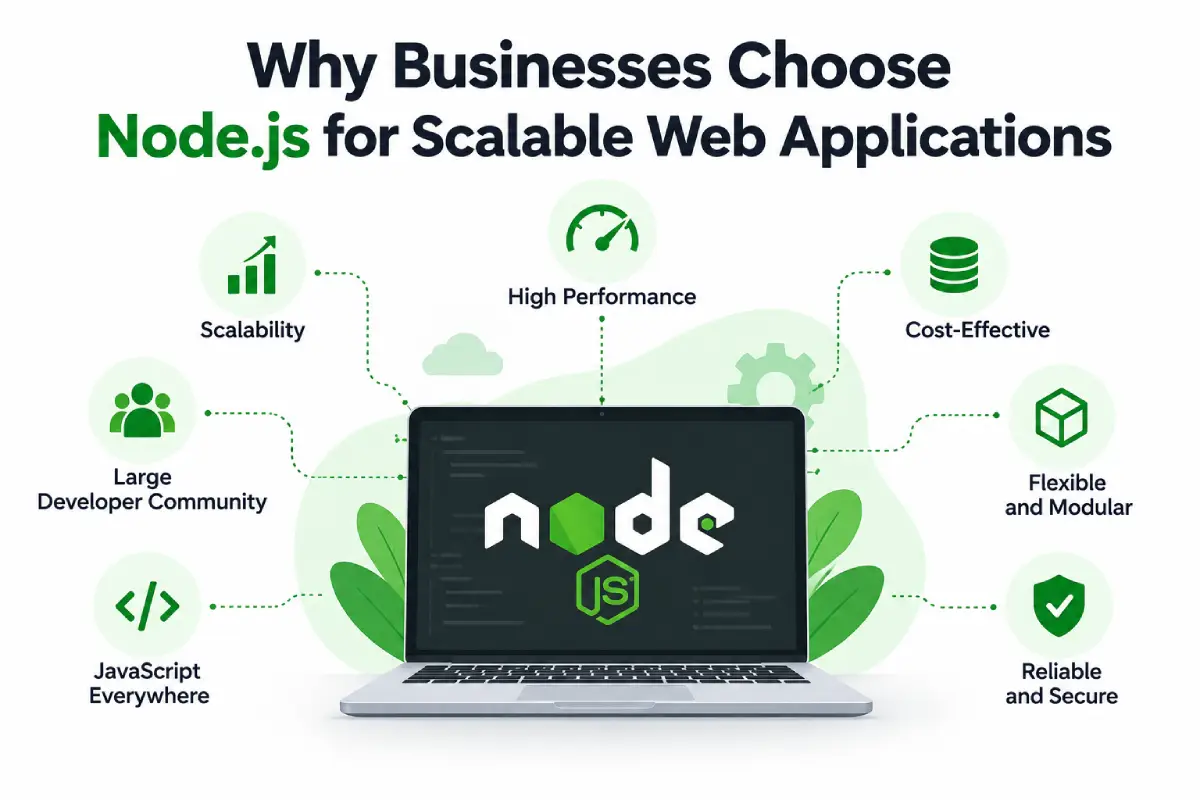
Why Businesses Choose Node.js for Scalable Web Applications


A web application may work perfectly fine when the engagement or your user is less on the number. Although a few hundred visitors may not affect your workflow, the challenge begins when traffic increases, users expect faster responses, and the application needs to handle more processes at once.
The backend technology of your website becomes relevant here. Your backend technologies need to handle that increasing traffic without increasing the infrastructure cost.
How is that possible?
This is when Node.js development becomes a first choice of businesses that need to scale their web application in order to avoid hassle and avoid crashing to manage multiple operations.
In this article, I will give a complete explanation of why your business needs Node.js web applications so that by the end of the article, it will help you make a decision whether you should consider it for your business.
Table Of Contents
| 1. | Introduction |
| 2. | What Is Node.js? |
| 3. | Why Do Businesses Need Node.js? |
| 4. | When Should Businesses Consider Node.js? |
| 5. | Choosing Node.js Based on Your Application Needs |
| 6. | Is Node.js Right for Every Web Application? |
| 7. | FAQ |
| 8. | Build a Scalable Web Application With the Right Technology |
What Is Node.js?
Node.js is an open-source JavaScript runtime that is built on Chrome and used to run JavaScript outside the browser in the backend for serverside development.
Node.js development allows developers to use JavaScript for server-side application logic, APIs, backend services, and other parts of a web application.
So, it means that Node.js creates a premier runtime environment for building high-performance, enterprise-grade business applications, letting your business handle high-traffic workloads efficiently while keeping infrastructure costs low.
Why Do Businesses Need Node.js?
Netflix, PayPal, Uber, and LinkedIn rely on Node.js to scale their operations, handle millions of concurrent connections, and slash page load times. There are so many benefits that businesses get from using Node.js in their web applications.
Handles a High Number of Concurrent Requests
Node.js uses an event-driven, non-blocking architecture, which allows you to manage multiple operations like form submissions or requests simultaneously.
Businesses that operate in chat applications, social networks, or even the backend applications that need to manage multiple users by operating multiple operations together.
But here is a point to remember: using Node.js does not automatically mean scalability. There are multiple other factors, like architecture, infrastructure, database design, caching, and application code, that also affect scalability.
Supports Real-Time Web Applications
Many modern web applications need to respond to users immediately. Whether it is a new chat message, a live notification, or an updated tracking status, users expect information to appear without constantly refreshing the page.
Node.js is well suited to these real-time use cases because its event-driven architecture can efficiently handle multiple concurrent connections. Technologies such as WebSockets can also enable continuous, two-way communication between the application and the user.
For businesses building applications where users need immediate updates, Node.js can provide a strong foundation for real-time functionality.
JavaScript Across the Application Stack
Another reason businesses choose Node.js is the ability to use JavaScript across both the frontend and backend of an application. For businesses, this can simplify collaboration between frontend and backend developers and reduce the need for teams to work across multiple programming languages.
Developers can also reuse familiar knowledge, tools, and practices across the application stack.
Using one language does not automatically make development faster, but a consistent JavaScript-based stack can make collaboration and development workflows more straightforward.
Large Ecosystem of Packages and Tools
Building a web application often involves solving many common development requirements, from authentication and validation to testing and database connectivity.
Node.js benefits from a large ecosystem of reusable packages available through npm, its standard package manager. These packages provide developers with pre-built solutions and tools for a wide range of application requirements.
When the appropriate packages are selected and implemented correctly, they can help reduce development effort and support faster application development.
For businesses, the broader ecosystem can make it easier to build, extend, and maintain web applications without reinventing common solutions.
Works Well for API-Driven Applications
Modern web applications rarely operate in isolation. They often need to exchange data with other applications, services, and systems through APIs.
An application may need to connect its frontend with databases, mobile applications, payment platforms, third-party services, or internal business systems.
This makes Node.js relevant for businesses building applications that depend on multiple integrations or need to provide the same backend services to different platforms.
A well-designed Node.js backend can serve as a central layer connecting these systems, helping applications exchange data and perform actions efficiently.
For businesses, this flexibility can be particularly valuable as an application grows and its integration requirements become more complex.
Can Support Applications as They Grow
A web application that starts with a small user base may eventually need to support significantly more traffic, users, features, and integrations. Businesses therefore need a technology stack that can fit into an architecture capable of evolving with those requirements.
Node.js can be used as part of scalable architectures that incorporate techniques such as horizontal scaling, load balancing, microservices, and cloud infrastructure.
For example, additional application instances can be deployed to distribute traffic as demand increases. Larger applications can also separate different services so that individual components can be developed and scaled independently.
When Should Businesses Consider Node.js?
Node.js can be a strong option when the requirements of a web application align with its strengths. Businesses may consider Node.js when building high-traffic web applications, real-time platforms, SaaS products, e-commerce applications, APIs, or backend services that need to manage many concurrent connections.
It can also be useful for applications that require frequent integrations with third-party platforms or need to serve multiple clients, such as web and mobile applications.
However, Node.js is not automatically the right choice for every project. Application workload, performance requirements, integrations, development expertise, and long-term architecture should all be considered before selecting a technology stack.
Choosing Node.js Based on Your Application Needs
The best way to evaluate Node.js is to connect its capabilities with the actual requirements of the application.
| Business requirement | Why Node.js may fit |
| High concurrent traffic | Designed to efficiently handle many connections |
| Real-time functionality | Event-driven architecture supports real-time use cases |
| API-heavy architecture | Widely used for backend and API development |
| JavaScript development team | Enables JavaScript across frontend and backend |
| Faster development workflows | Large ecosystem of reusable packages and tools |
| Growing application | Can fit into architectures designed for scalability |
This approach provides a more useful question than simply asking whether Node.js is “better” than another technology. The important question is whether its capabilities align with what the business needs to build.
Is Node.js Right for Every Web Application?
While Node.js offers several advantages, it is not the ideal solution for every type of application.
Applications with intensive CPU-bound workloads may require additional architectural considerations. Poorly designed Node.js applications can also experience performance or scalability problems, just like applications built with other technologies.
Scalability depends on the complete system, including application architecture, databases, infrastructure, caching, and deployment strategy.
Developer expertise should also be considered when selecting a technology stack. Choosing Node.js should ultimately be based on the application’s requirements, team capabilities, and long-term goals rather than technology popularity alone.
FAQ:
Yes. Node.js can support scalable web applications by efficiently handling concurrent connections and fitting into architectures designed for growing traffic.
Businesses use Node.js for its ability to handle concurrent requests, support real-time applications, build APIs, and provide a large ecosystem of development tools.
Node.js can be suitable for high-traffic websites, especially when the application is properly designed with scalable architecture, infrastructure, databases, and caching.
Yes. Node.js is commonly used for real-time applications such as chat platforms, live notifications, dashboards, tracking systems, and collaboration tools.
No. The right technology depends on the application’s workload, performance requirements, architecture, integrations, and the development team’s expertise.
Build a Scalable Web Application With the Right Technology
Node.js has become a popular option for modern web application development because it combines efficient request handling, real-time capabilities, a broad ecosystem, and JavaScript-based development.
But choosing the right technology is only one part of building a scalable application. Architecture, integrations, security, infrastructure, and long-term development requirements all influence how well an application performs as it grows.
If you’re planning a new web application or looking to scale an existing one, the right development approach starts with understanding your business requirements and choosing the technology stack accordingly.