AI Memory Systems: The Future of Website Personalization in 2026


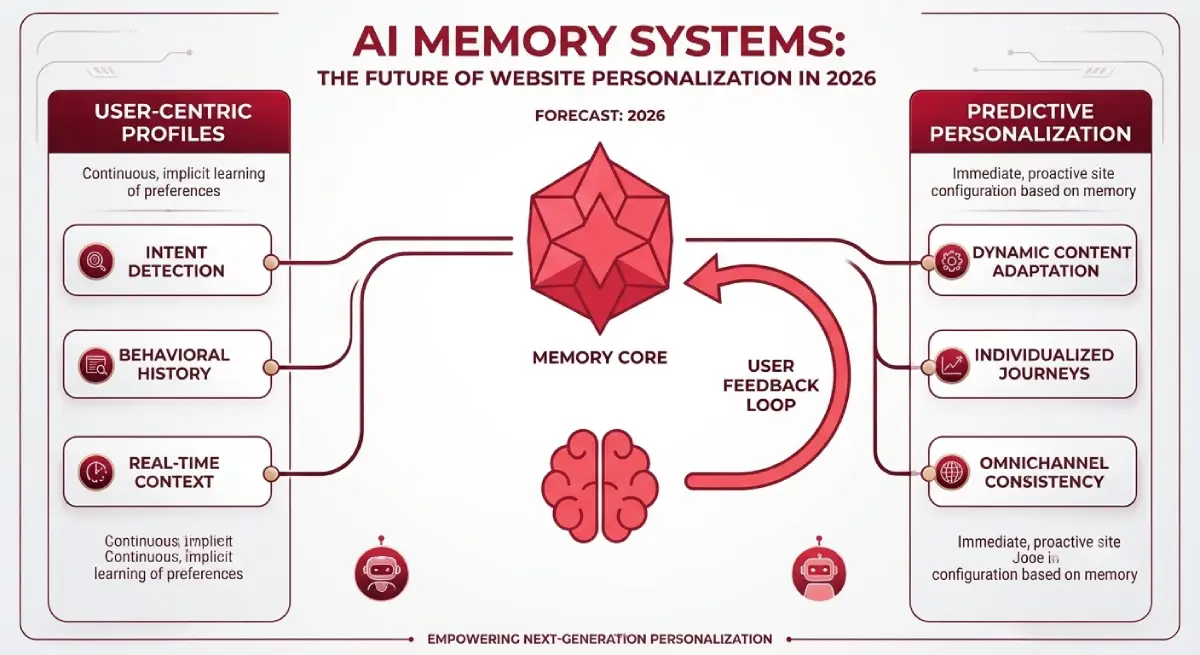
Have you ever returned to a website only to explain your preferences all over again? You may have already searched for products, compared options, or discussed your requirements with an AI assistant, yet the website treats you like a first-time visitor.
Traditional websites have this limitation of personalization. While websites can track browsing behavior and purchase history, they do not always understand the context behind a customer’s decisions.
AI memory systems are changing it.
By allowing AI applications to retain and retrieve relevant information from previous interactions, they can support more continuous, context-aware customer experiences. In 2026, this capability is becoming an important part of the conversation around AI personalization, customer experience AI, and adaptive websites.
Table Of Contents
| 1. | Introduction |
| 2. | What Are AI Memory Systems, and How Do They Work? |
| 3. | Why Are AI Memory Systems Becoming Important in 2026? |
| 4. | How AI Memory Systems Are Changing Website Personalization |
| 5. | Real-World Applications Across Industries |
| 6. | Benefits of AI Memory Systems for Businesses |
| 7. | Challenges of Implementing AI Memory Systems |
| 8. | How Businesses Can Prepare Their Websites for AI-Powered Personalization |
| 9. | Conclusion |
| 10. | FAQ |
| 11. | Ready to build smarter digital experiences? |
What Are AI Memory Systems, and How Do They Work?
AI memory systems allow artificial intelligence applications to store, retrieve, and use relevant information from previous interactions. Instead of treating every conversation as an isolated event, these systems can use retained context to make future responses more relevant.
For example, a customer visiting an online electronics store. They tell its AI assistant that they need a laptop for video editing, have a budget of ₹80,000, and prefer lightweight devices.
Without persistent memory, the customer might need to provide these details again during their next visit. With an appropriately configured AI memory system, the assistant could retrieve those preferences and recommend suitable laptops without repeating the entire discovery process.
AI memory generally involves several capabilities:
- Short-term memory: Retains information relevant to the current conversation or session.
- Long-term memory: Stores selected information that can be retrieved across multiple interactions.
- Episodic memory: Records details about specific past interactions or events.
- Semantic memory: Retains general information, preferences, and facts.
A typical memory-enabled AI workflow involves collecting relevant information, storing it, retrieving it when needed, and using it to generate an appropriate response. This process may involve AI models, databases, vector stores, and retrieval mechanisms.
Why Are AI Memory Systems Becoming Important in 2026?
Website personalization has traditionally relied on browsing history, cookies, purchase records, and predefined recommendation rules. These methods can be useful, but they do not always capture a customer’s intentions or changing requirements.
AI memory systems introduce another layer by allowing systems to incorporate information from previous conversations and interactions.
Three developments are making this capability particularly relevant.
1. Personalization Beyond Browsing Behavior
Customers increasingly expect digital experiences to reflect their preferences and requirements. Remembering that someone viewed a product is useful, but understanding why they viewed it can provide more meaningful context.
For example, an online retailer could use an AI assistant to remember a customer’s preferred brands, budget, and product requirements when suggesting future purchases.
2. AI Agents Becoming Context-Aware
AI agents are increasingly being developed to handle multi-step tasks, from product discovery to customer support. However, repeatedly asking customers for information they have already provided can interrupt these experiences.
Memory can help agents maintain continuity and make interactions more efficient.
3. Websites Becoming More Adaptive
Instead of presenting identical experiences to every visitor, businesses can use AI personalization to adjust recommendations, content, and support based on relevant customer context.
Together, these developments are creating opportunities for more responsive digital experiences.
How AI Memory Systems Are Changing Website Personalization
AI memory systems can influence different stages of the customer journey.
1. More Relevant Product Recommendations
Traditional recommendation engines often rely on browsing patterns and purchase history. Memory-enabled AI can also incorporate customer-stated preferences and requirements.
An e-commerce website, for instance, could remember that a customer prefers fragrance-free skincare products and use that information to narrow future recommendations.
2. Context-Aware Customer Support
Customers often have to explain their problems repeatedly when contacting support. An AI assistant with access to relevant interaction history could retrieve previous support conversations and provide more contextual assistance.
This can reduce repetitive communication and help customers continue unresolved tasks.
3. Personalized Website Content
AI-powered adaptive websites can prioritize content based on a visitor’s interests and previous interactions.
A returning visitor interested in web development services, for example, might see relevant case studies, technical guides, or service information instead of generic introductory content.
4. Consistent Experiences Across Multiple Sessions
A customer researching a service today may want to continue the same journey several days later.
AI memory can help preserve relevant context, allowing the website assistant to continue from previous discussions rather than starting from scratch.
Real-World Applications Across Industries
AI memory systems have potential applications across several industries.
- E-commerce: Remembering shopping preferences, product requirements, budgets, and previously compared items.
- SaaS platforms: Retaining information about user workflows, feature interests, and previous support issues.
- Travel and hospitality: Using saved destination preferences, travel requirements, and budgets to personalize recommendations.
- Online education: Remembering learning progress, completed lessons, and topics that require additional practice.
These applications demonstrate how AI memory could support more relevant and continuous customer experiences.
Benefits of AI Memory Systems for Businesses
When implemented effectively, AI memory systems can create value for both customers and businesses.
For customers, they can reduce repetitive communication, improve recommendation relevance, and make it easier to continue previous interactions.
For businesses, they create opportunities to improve customer engagement, streamline support workflows, and deliver more relevant product and service recommendations.
They can also help businesses move beyond generic website experiences towards more context-aware interactions.
However, these outcomes are not automatic. Their effectiveness depends on memory accuracy, data quality, integration, and how well the system understands customer requirements.
Challenges of Implementing AI Memory Systems
Despite their potential, AI memory systems introduce important implementation challenges.
Data privacy and consent: Businesses need to establish clear rules about what information they collect, store, and use. Customers should understand how their information is handled.
Data security: Stored customer information must be protected through appropriate security measures and access controls.
Inaccurate or outdated memories: AI systems may retain incorrect information or continue using preferences that customers no longer have. Memory needs to be reviewed and updated appropriately.
Integration complexity: Connecting memory systems with existing websites, CRM platforms, databases, and AI applications requires careful technical planning.
Customer control: Users should have appropriate options to review, correct, and delete stored information.
Addressing these challenges is essential to building trustworthy AI-powered customer experiences.
How Businesses Can Prepare Their Websites for AI-Powered Personalization
Businesses interested in adopting AI memory systems should start by identifying where customers repeatedly provide the same information or experience interruptions during their website journeys.
A few practical steps can help:
- Evaluate existing customer interactions: Identify repetitive questions, common preferences, and opportunities for more contextual experiences.
- Build a reliable data foundation: Organize relevant customer information and establish appropriate data management practices.
- Integrate AI memory into website workflows: Identify where retaining context could improve product discovery, support, or other customer interactions.
- Prioritize privacy and security: Establish consent, data retention, and deletion policies.
- Measure performance: Evaluate memory accuracy, customer satisfaction, support efficiency, and the relevance of recommendations.
Businesses do not necessarily need to rebuild their websites to begin exploring these capabilities. They can start with specific workflows and expand as their requirements evolve.
Conclusion
Website personalization is moving beyond understanding what customers click towards understanding the context behind their interactions.
AI memory systems can support this transition by helping websites and AI agents retain relevant information, recognize preferences, and provide more continuous experiences.
For businesses, this creates an opportunity to rethink how their websites interact with customers. The focus is no longer just on displaying relevant content but also on making digital experiences more responsive to individual needs.
As AI personalization continues to evolve in 2026, businesses should start exploring how memory-enabled AI and adaptive website technologies can improve their customer experiences.
FAQ:
AI memory systems allow artificial intelligence applications to retain and retrieve relevant information from previous interactions, helping them provide more contextual responses.
They allow websites and AI assistants to use relevant customer preferences, previous conversations, and interaction history to provide more personalized recommendations and support.
Traditional personalization often relies on browsing behavior and purchase history. AI memory can additionally use retained conversational context and customer-stated preferences.
Yes. When persistent memory is implemented with appropriate storage, retrieval, and user permissions, AI-powered websites can use selected preferences across multiple sessions.
They can be implemented securely, but businesses must use appropriate encryption, access controls, consent mechanisms, retention policies, and data protection practices.
Ready to build smarter digital experiences?
Explore our AI solutions to discover how AI integration, custom development, and intelligent website technologies can help your business create more adaptive and customer-focused digital experiences.