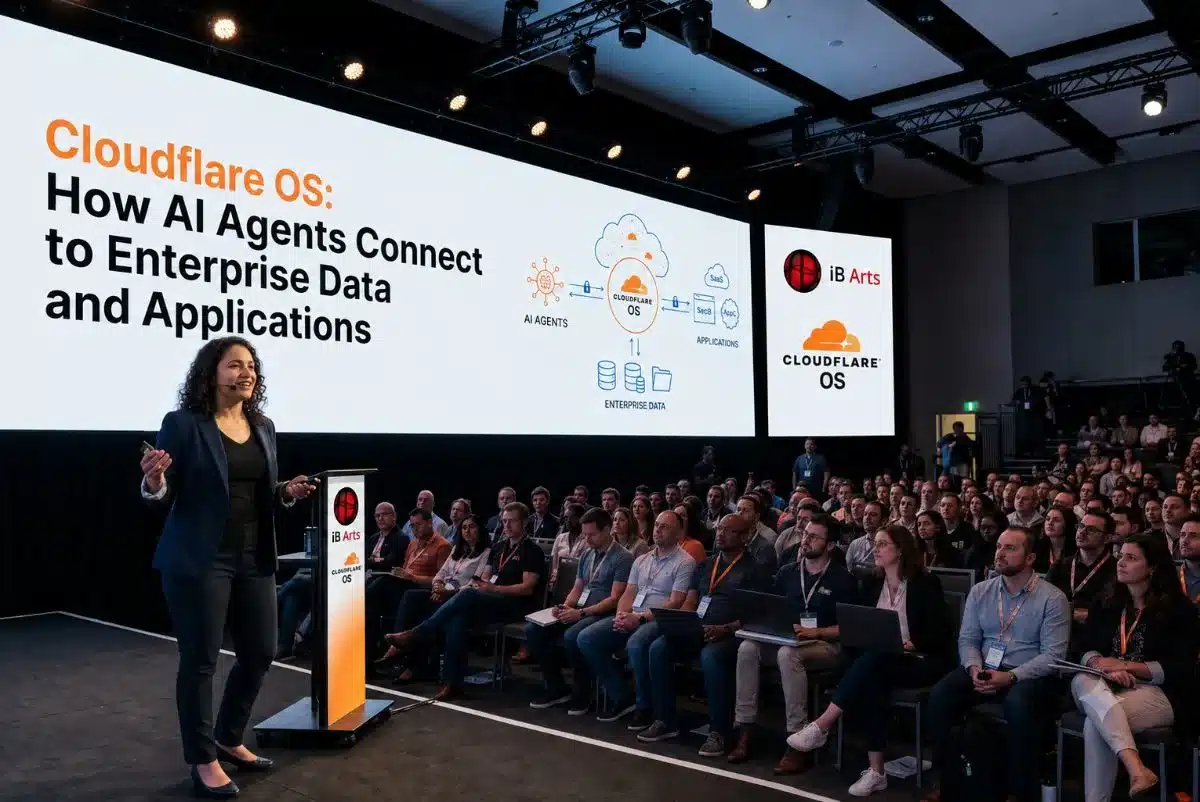
Cloudflare OS: How AI Agents Connect to Enterprise Data and Applications


Remember those videos on social media where robots would sit with a computer and do the tasks?
Although it seemed funny and imaginative back then, it is no longer an impossible future. Except there would not be a robot physically present to do the work.
AI is increasingly getting wider in every sector, and now recent technologies suggest that it is capable of performing tasks for your enterprises too. But how does an AI agent actually connect with enterprise data and applications to perform the tasks?
This is where Cloudeflare OS answers the question.
In this guide, you will get a complete A to Z framework from how AI agents connect to enterprise data and applications to how to enable Cloudflare OS for your enterprise/businesses to let AI do your work without compromising security.
Table Of Contents
| 1. | Introduction |
| 2. | Why AI Agents Need Access To Enterprise Systems |
| 3. | What Makes Enterprise Data Difficult For AI Agents To Access? |
| 4. | How AI Agents Connect To Enterprise Data and Applications |
| 5. | Where Cloudflare OS Fits Into This Architecture |
| 6. | How MCP Connects AI Agents to Enterprise Systems |
| 7. | Securing AI Agent Access |
| 8. | Making Enterprise Data AI-Ready |
| 9. | FAQ |
| 10. | Conclusion |
| 11. | Make AI Agents Work for Your Business! |
Why AI Agents Need Access To Enterprise Systems
AI is moving forward from just answering queries of the users. From giving tailored answers to finding products or services and comparing prices, AI is going through a significant transformation in the online sector.
Today AI is also capable of doing tasks. It has moved beyond conversational functionality. It can not just take action but also plan and reason to achieve the goal of the given task. It is called agentic AI.
What is Agentic AI?
Agentic AI is artificial intelligence that acts as an agent to achieve a specific goal given to them with as little supervision as possible.
Google Cloud says it is an advanced form of artificial intelligence that focuses on autonomous decision-making and performing actions. It goes beyond creating images or texts and videos by executing tasks underlying in systems.
| Conversational AI | Agentic AI |
|---|---|
| Primarily responds to user questions or prompts. | Understands goals and takes actions to achieve them. |
| Generates answers based on available context and data. | Can access tools, APIs, tools, external sources. |
| Usually follows a request-response pattern. | Can plan and execute multi-step actions. |
| Limited availability to interact with enterprise systems. | Can interact with CRMs, ERPs, databases, APIs, and other applications. |
| Focused on conversation and information only. | Focused on autonomous actions and task completion. |
That is why your system does not give these agentic AI to do your task; it will not be able to perform the work. Also, making your systems for AI agents to use is not enough. It is a long process. Security and permissions are non-negotiable.
What Makes Enterprise Data Difficult For AI Agents To Access?
You may thing, you will give ChatGPT a command to create a report on your sales of products, and it will do the work for you.
But this is not how agentic AI work. Enterprise or business data is fragmented, scattered around many poages and sites. AI does not read like humans to navigate each page to understand what each page does and choose accordingly.
This may look like;

So, the AI agent needs information from multiple sources to perform a task. Let’s take an example prompt to understand this better.
“Find customers whose contracts expire next month, check whether they’ve opened support tickets recently, and prepare a renewal recommendation.”
To execute this task, AI needs to go though multiple pages, like, CRM, contract management system, Support platforms, analytics etc. the AI agent will look for the data which needs to perform the task on all of those sources.
Here API plays the role. But simply having an API does not solve the problem alone. If the documentation is incomplete, endpoints are not consistent, authorization is not authenticated, and the API is not designed for AI workflow, problems will remain.
So, what makes the enterprise data difficult to use by AI agents is not the data by itself but the system, the architecture of your website, AI incompatibility, API, data layer, etc.
How AI Agents Connect To Enterprise Data and Applications
Now that we have learned what makes your enterprise data difficult for AI to use, let’s get to know in detail how AI agents actually interact with enterprise data and applications.
API
An API is an underlying mechanism that allows AI agents to connect with systems to connect. If an AI agent needs to check your CRM system, it will not look for the required information one by one like we humans do.
API allows the AI agents to connect to the information.
Tools
AI agents need more than raw APIs. They need clearly defined actions, or tools, that they can understand and invoke based on the task. For example, tools such as search_customer, check_order_status, or create_support_ticket turn application capabilities into actionable functions. This creates a bridge between what the agent wants to accomplish and what the software can do.
MCP
Model Context Protocol (MCP) provides a standardized way for AI applications to interact with external tools and resources. It allows agents to discover and use capabilities exposed by systems such as CRMs, ERPs, and support platforms.
Importantly, MCP does not replace APIs. APIs can continue to provide the underlying application functionality, while MCP can serve as a standardized interaction layer between AI applications and those capabilities.
Data Layers
Agents need access not only to actions but also to the information required to make decisions. A data or API layer can bring information from sources such as CRMs, ERPs, databases, and knowledge bases into a more consistent and accessible format.
Technically the process looks like this:
AI Agent
↓
Tools / MCP
↓
APIs
↓
Enterprise Applications
↓
Enterprise Data
Where Cloudflare OS Fits Into This Architecture
Reading the above structure, you may think what does Cloudflare OS have to do in this process. What is missing in the current process is the security itself.
How do you ensure your enterprise data remains secure even if an AI agent is performing tasks autonomously? How do you know if AI does not access unwanted data?
Cloudflare OS is designed to perform these exact security features.
- Allows AI agents to access only the exact data that it needs to perform a specific task.
- Keeps credentials unrelated to the specific task hidden from unnecessary AI access.
- Prevents unwanted authorization and exposure of enterprise data outside.
- Follows what the AI agent has seen to use for its work and records every actions.
How MCP Connects AI Agents to Enterprise Systems
Model Context Protocol works as the aisle towards the door for an agent to identify the tools available to it and use the appropriate one for a task, whether that’s retrieving customer data, checking inventory, or creating a support ticket.
One important distinction is that MCP works with APIs, not as a replacement for them, although many people assume that.
APIs continue to provide the underlying functionality, while MCP helps AI applications interact with those capabilities consistently across systems such as CRMs, ERPs, databases, and internal applications.
Securing AI Agent Access
Connecting an agent to an enterprise system doesn’t mean giving it unrestricted access. Organizations need to verify who or what the agent is, authenticate its requests, and determine what actions it is authorized to perform.
Zero Trust, least-privilege access, and policy enforcement help ensure agents only access the systems and data required for a specific task.
This limits the impact of unauthorized or unintended actions while keeping agentic workflows under organizational control.
Making Enterprise Data AI-Ready
Secure access is only useful if agents can actually understand and use the data they retrieve. Enterprise data should be structured, consistent, discoverable, and machine-readable, with clearly defined schemas and well-designed APIs.
A strong data layer can connect information from sources such as CRMs, ERPs, databases, and knowledge bases, making it easier for AI agents to interpret information and use it reliably in their workflows.
FAQ:
AI agents generally need controlled interfaces such as APIs, tools, or other integration layers to access enterprise data. Simply giving an agent direct access to databases or applications can create security and governance risks.
MCP provides a standardized way for AI applications to discover and interact with external tools and resources. It can help agents work with capabilities exposed by systems such as CRMs, ERPs, databases, and internal applications.
No. MCP and APIs serve different purposes. APIs can expose an application’s underlying functionality, while MCP provides a standardized interaction layer that helps AI applications discover and use tools and resources.
APIs provide programmatic access to application functionality and data. Instead of navigating an application like a human user, an AI agent can use APIs to retrieve information or perform authorized actions.
AI-ready enterprise data should be structured, consistent, discoverable, machine-readable, and accessible through well-designed interfaces. Clear schemas and reliable APIs can make it easier for agents to interpret and use the data.
Zero Trust ensures that an AI agent is not automatically trusted simply because it can reach an enterprise system. Its identity and every access request can be evaluated against defined policies and permissions.
AI agents may perform actions autonomously, so giving them excessive permissions can increase security risks. Least privilege limits an agent to only the data and actions required for its specific task.
Conclusion
AI agents are moving beyond simply answering questions to performing tasks across enterprise systems. But for agents to work effectively, businesses need more than AI capabilities alone. They need connected APIs, well-structured data, accessible tools, and secure access controls.
Cloudflare OS fits into this architecture by helping enterprises build a secure foundation for AI-driven workflows. Combined with MCP, APIs, identity controls, Zero Trust, and AI-ready data layers, it can help organizations give AI agents controlled access to the information and applications they need.
Make AI Agents Work For Your Business!
Why fall behind with your competitors when you can integrate AI in your business too! iB Arts provides all kinds of digital solutions to make your website AI ready with WebMCP services, custom system design, advanced system engineering, and many more.